

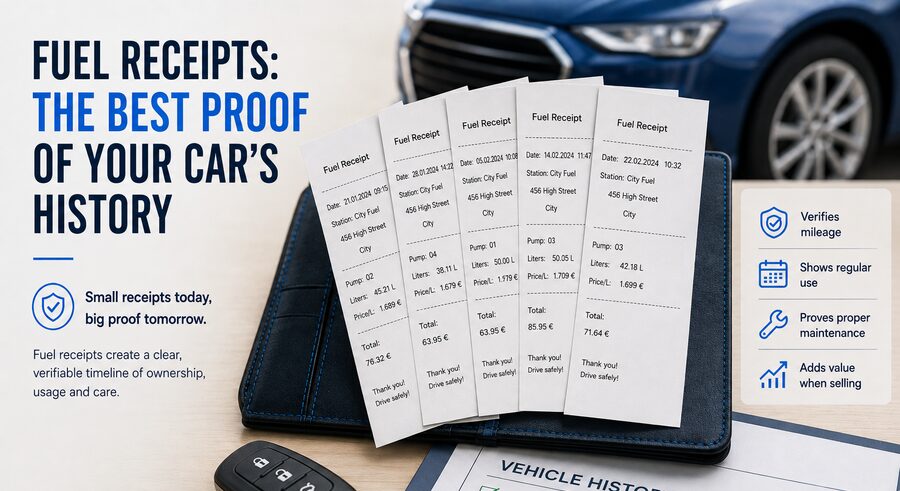
Whether you're buying or selling, the real question behind every used car deal is the same: how do you actually know how this car was used? The documents people reach for by default, service books and repair invoices, feel official. In practice they're some of the easiest paperwork on the whole transaction to fake, and fuel receipts, of all things, turn out to be a much sturdier alternative.
German police consumer guidance flags forged registration and service documents as a recurring pattern in car-purchase fraud, including blank registration papers obtained through theft and then filled in to match a different car. Independent vehicle-check services report the same problem one level down: service booklets with inconsistent workshop stamps, handwriting that shifts from entry to entry, or maintenance dates that don't line up with how the car was actually registered. None of this requires much sophistication. A stamp can be bought online, and a blank service booklet can be filled in over a weekend by anyone willing to try.
A single repair invoice is even simpler to produce: it's a document one party writes about itself, with no independent system checking the date, the amount, or whether the work happened at all.
A gas station receipt isn't written by the seller. It's printed automatically by the station's point-of-sale system at the moment of the transaction, with the date, time, and the station's own location baked in by a system the driver doesn't control. That's a structurally different kind of evidence than a document someone fills in by hand after the fact, and it's why a receipt is hard to fabricate convincingly on its own, let alone as part of a longer, internally consistent series.
Any single piece of paper can theoretically be edited. The real value was never in one receipt anyway, it's in the pattern that builds up across dozens of them over months or years. A believable fuel history has to show a car buying roughly the right amount of fuel for its tank size, at a plausible interval, at stations that make geographic sense next to each other. Faking one convincing receipt is easy. Faking a long, internally consistent series that holds up against all of that at once is a much bigger and more fragile undertaking than filling in a blank service booklet once.
Fuel amount alone tells you what was bought. Fuel amount plus an odometer reading at the same moment tells you how far the car actually travelled between fill-ups, and lets that number be checked against the car's known fuel consumption for a sanity check that a receipt alone can't offer. That's the pairing worth building the habit around: snap the receipt, and while you're standing at the pump, snap the odometer too.
INC Ride's Fuel History tool records more than what's printed on the receipt. It also timestamps when you actually added the entry, separately from the date on the receipt itself. That matters because it means a usage history can't be assembled from a shoebox of old paper and backdated in a single afternoon right before a sale. It has to be built one fill-up at a time, for as long as you've actually owned the car.
Nothing here is a claim that fuel receipts are impossible to forge. Someone determined enough could still try, the same as with any other document. The point isn't to be theoretically unforgeable, it's to be dramatically more work to fake convincingly than the alternative, while costing the honest driver nothing more than a photo each time they fill up.
You don't need to reconstruct years of history to start. Fuel History reads the date and fuel amount off a photo automatically, and archives it to your car's record. Add an odometer reading when you can, and by the time you're ready to sell, you'll have a dated usage history to hand a buyer instead of just a number on a dashboard.